- FinTech
- Financial Data
- AI
- Information Systems
Building HISSA
Financial technology, financial data, and research for Indonesia's Sharia capital market.
HISSA is a platform for researching Indonesian Sharia-compliant equities. My work on the platform has involved software engineering, financial-data systems, analytics, and research experiments.
- Role
- CTO & Lead Programs
- Organization
- PT Syariah Saham Indonesia
- Pipeline
- 7-Stage HITL
A research platform for Indonesia's Sharia capital market
Bridging structured equity disclosures, Sharia compliance rules, and practical investor research workflows.
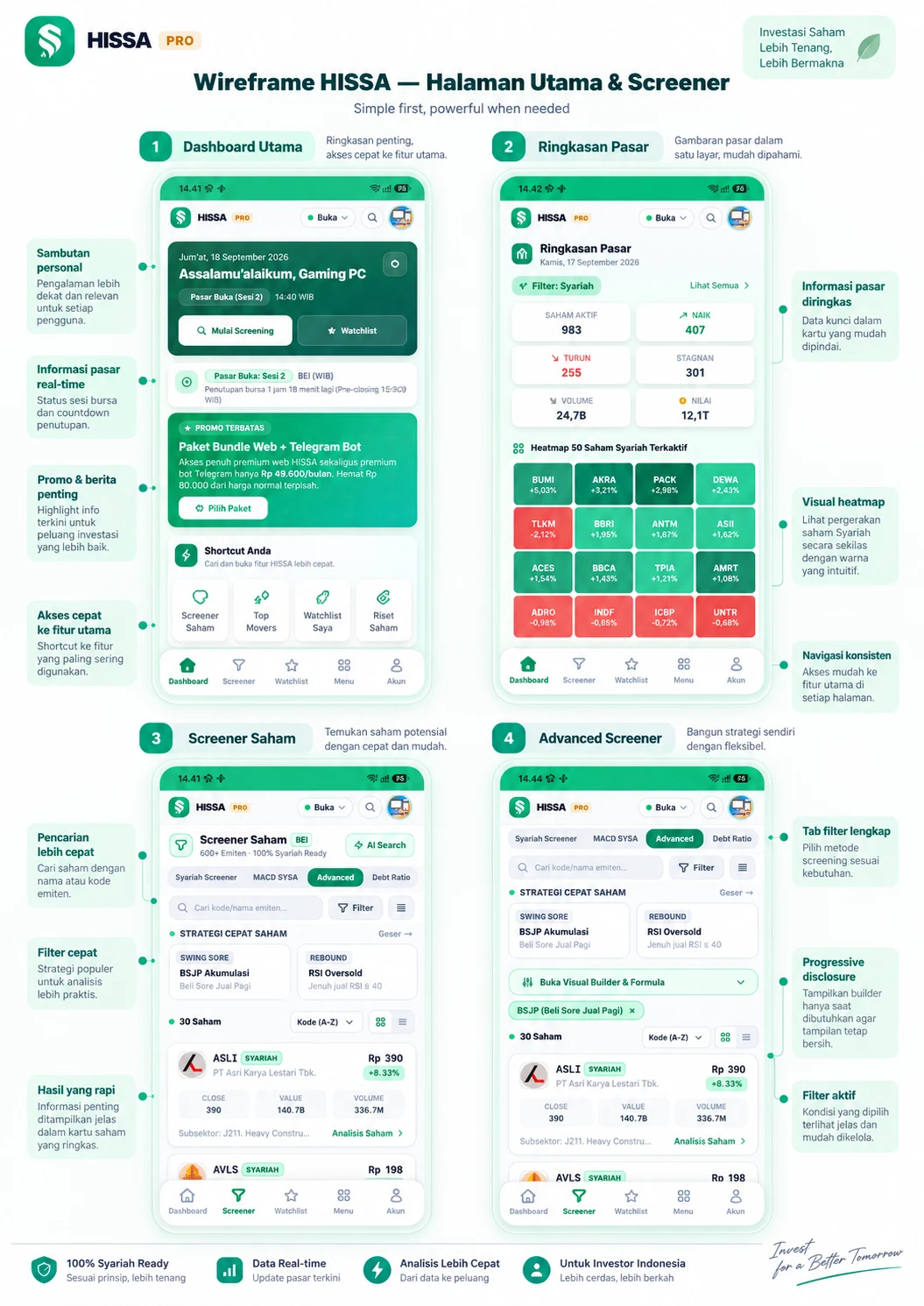
HISSA brings together structured financial information, stock screening, company fundamentals, analytics, and research tools for Indonesian Sharia-compliant equities.
The production interface is primarily in Bahasa Indonesia. This page explains the product, my contribution, and the research questions behind the work for an international audience.
Financial information is available. Making it usable is harder.
Three recurring challenges shaped both the product and the questions I began to investigate.
Fragmented financial data
Financial information arrives through different reports, providers, formats, and structures.
Domain-specific interpretation
Raw numbers need context before they become meaningful information for financial research.
Human decision-making
Financial systems should support understanding, not simply output automated conclusions.
Inflection Point These problems turned HISSA from a software project into something that also raised research questions for me.
What I worked on
Ownership across architecture, data engineering, research prototyping, and team alignment.
CTO & Lead Programs
PT Syariah Saham Indonesia
My work spans product architecture, software development, financial-data systems, research experimentation, and technical team coordination.
- 01 Product architecture
- 02 Backend and frontend development
- 03 Financial-data workflows
- 04 Database design
- 05 Research prototyping
- 06 Technical planning and coordination
- 07 Machine-learning experimentation
- 08 Mentoring and technical coordination
Selected capabilities
Public capabilities are described here without exposing the internal methods that make them work.
Financial data aggregation
Collecting and structuring financial information into formats usable by the application.
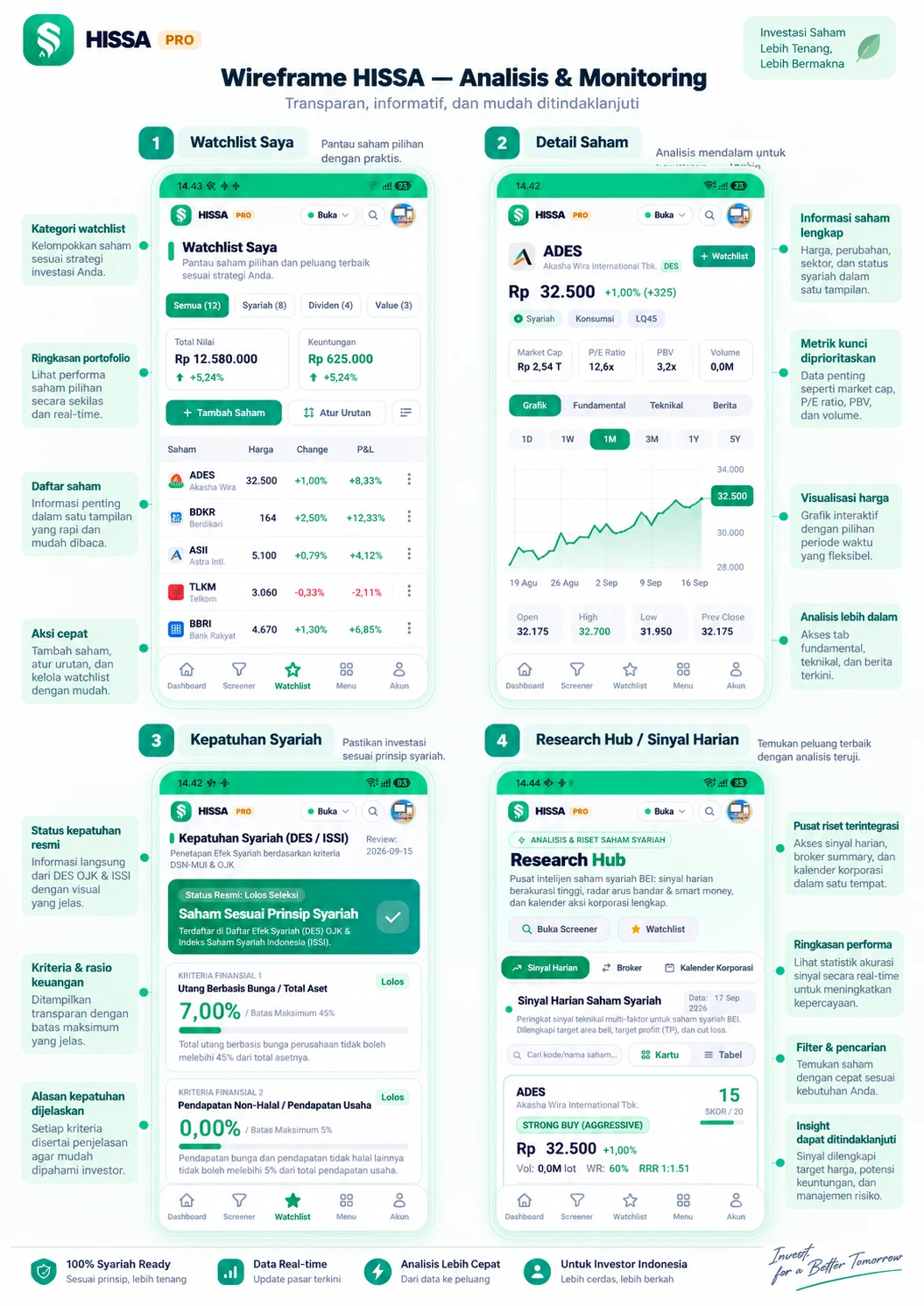
Sharia stock research
Supporting research workflows focused on Indonesian Sharia-compliant equities.
Stock screening
Helping users explore companies through structured indicators and financial information.
Company fundamentals
Presenting financial information for clearer company analysis and comparison.
Market analytics
Visualizing financial and market data to support exploration and research.
Machine-learning experiments
Exploring ML-based approaches to financial analysis and decision-support research.
Built around real research workflows
Two annotated wireframes explain the product's key research and monitoring workflows.
When engineering problems become research questions
Building HISSA repeatedly created questions that could not be answered only by writing more code.
- Q01
How should financial information be collected when the source environment is difficult to automate reliably?
- Q02
Which parts of a financial-data pipeline should remain human-validated?
- Q03
How can Sharia screening remain transparent and traceable as source data changes?
- Q04
How can machine-learning systems support financial analysis without hiding uncertainty from users?
- Q05
How should intelligent systems balance automation, explainability, and human judgment?
- Q06
How can financial information systems transform fragmented data into useful decision-support tools?
Research methodology overview
How fragmented financial disclosures are transformed into structured, explainable, and human-validated decision support.
HISSA began as an engineering problem: how can fragmented financial information be transformed into structured, explainable, and useful decision support?
As the system evolved, engineering challenges increasingly became research questions involving data reliability, human validation, Sharia screening, financial analytics, and machine-assisted analysis.
- 01
Financial Data Sources
- 02
Data Collection & Normalization
- 03
Validation & Human Review
- 04
Sharia Screening
- 05
Financial & Market Analysis
- 06
Machine-Assisted Analysis
- 07
Explainable Decision Support
Data Sources & Evidence
HISSA works across public and structured evidence categories while attempting to preserve traceability between derived information and its source.
- Official market and issuer disclosures
- Company financial statements
- Structured market data
- Publicly available regulatory information
- Internally normalized financial datasets
Sharia Screening Framework
HISSA evaluates securities in the context of Indonesian Sharia capital-market principles and relevant regulatory criteria.
- 01
Business Activity Screening
Reviewing whether a company's primary activities are compatible with applicable Sharia principles.
- 02
Financial Ratio Screening
Evaluating relevant financial ratios against applicable Sharia screening criteria without treating one ratio as the whole assessment.
- 03
Regulatory / Reference Status
Consulting relevant official or authoritative Sharia securities references where applicable.
- 04
Validation
Keeping screening results traceable and reviewable instead of presenting an unexplained binary output.
Screening criteria may evolve as regulations, source data, and methodological interpretations change.
Human-in-the-Loop Validation
HISSA does not assume that every financial-data problem should be fully automated.
- Extraction
- Normalization
- Repetitive processing
- Anomaly flagging
- Preliminary analysis
- Ambiguous-data review
- Validation
- Contextual interpretation
- Exception handling
- Methodological oversight
Automation should reduce repetitive work without removing human judgment where ambiguity, financial interpretation, or methodological uncertainty remains.
Analytical Framework
Analysis is treated as a set of connected layers rather than one opaque score. Each layer adds context while preserving a role for uncertainty and review.
- L01
Data Integrity
- L02
Sharia Eligibility
- L03
Fundamental Context
- L04
Market Behaviour
- L05
Quantitative / Machine-Assisted Signals
- L06
Human Interpretation
From a working product toward a research direction
This progression describes how the questions have evolved. It is not a claim that HISSA is already an academically validated research system.
- 01
Software Project
- 02
Data System
- 03
Analytical Platform
- 04
Research Questions
- 05
Research-Oriented Financial Information System
Research shaped by building
Design of Human-in-the-Loop Semi-Automated Pipelines for Financial Data Aggregation in Restricted Web Environments
This research explores a semi-automated financial-data workflow in which automation handles repeatable processing while human validation remains part of the pipeline when source environments make fully automated extraction unreliable.
- Financial data
- Human-in-the-loop
- Automation
AI-Orchestrated Development Methodology (Vibe Coding)
Research exploring how AI models can participate across the software-development lifecycle while humans remain responsible for architecture, verification, and final decision-making.
- AI orchestration
- Verification
- Software engineering
What I want to understand next
How can we build intelligent systems that are technically capable while remaining useful, understandable, and responsible for the humans who use them?
Financial Systems
The technology, at a deliberate distance
Enough context to show the working domains, without publishing production architecture or proprietary methods.
- Laravel
- Vue
- Inertia
- Livewire
- Tailwind CSS
- MySQL
- Financial-data pipelines
- Python
- XGBoost
- Machine learning
- Notebooks
- Linux
- Git
- Production hosting

Student, builder, and researcher from Indonesia
I'm Iqbal Muhammad Adiatma, a final-year Software Engineering student from Indonesia.
I enjoy building systems around real problems involving data, automation, financial technology, and human decision-making.
My current academic interests sit at the intersection of Artificial Intelligence, Financial Technology, Information Systems, and Software Engineering.
See the product in context, or continue the academic conversation.
The production product is primarily designed for Indonesian users and currently uses Bahasa Indonesia.